


Honors and Awards
Union Fellow
Received December 2025
James B. Macelwane Medal
Received December 2025
Citation
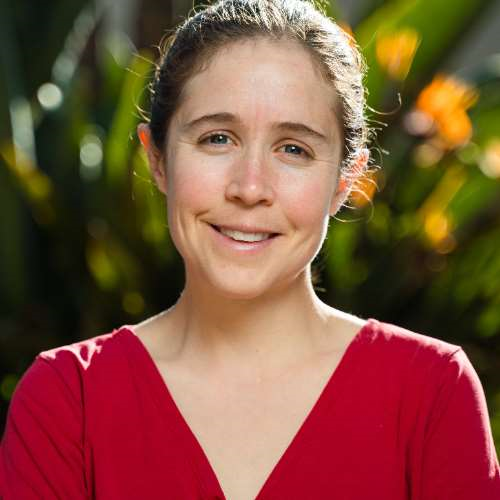
Anna Trugman has reshaped how the Earth science community understands forest responses to drought and disturbance by linking plant physiological mechanisms to landscape‑ and global‑scale dynamics. She integrates observations, experiments, and process‑based models to reveal how hydraulic constraints, stomatal regulation, and carbon allocation jointly control vegetation function under stress. Trugman devised rigorous methods to diagnose water stress and photosynthetic limitations across Earth system models, enabling transparent, cross‑model comparisons of the processes governing carbon uptake during drought. By clarifying when and why models diverge, her work sets a higher bar for representing plant water use, photosynthesis, and mortality in coupled climate-biosphere simulations.
Equally influential is her introduction of “trait velocities,” a quantitative framework that measures how rapidly forest communities can adjust hydraulic and functional traits relative to the pace of climate change. This insight reveals a fundamental rate mismatch: Community‑level adaptation often lags shifting hydroclimatic regimes, increasing the risk of productivity declines and mortality events, with consequences for ecosystem resilience and the global carbon cycle. Trugman’s research further demonstrates that disturbance legacies such as fire and insect outbreaks amplify drought sensitivity by restructuring stand demography and trait distributions, revealing compound risks that emerge only when physiology, ecology, and disturbance dynamics are considered together.
Trugman converts fundamental discovery into decision‑relevant information. Her team’s probabilistic maps of drought mortality risk for iconic Western conifer forests are informing stewardship and climate adaptation strategies. More broadly, her open, mechanistic approach provides managers and modelers with diagnostics that distinguish hydraulic failure from carbon-starvation pathways, identify thresholds, and prioritize the observations most likely to reduce predictive uncertainty. Through this scholarship, she has established a durable, process‑based foundation for representing vegetation stress and mortality in Earth system models and for assessing carbon‑climate feedbacks under intensifying extremes.
Beyond the science, Trugman builds community. She mentors and collaborates across disciplines, from plant physiology and community ecology to remote sensing and Earth system modeling, and she advances open data, transparent code, and reproducible workflows. Her leadership exemplifies the Macelwane Medal’s spirit of bold, original advances that transform understanding and equip society to navigate a changing climate.
For pioneering contributions that connect plant traits to ecosystem resilience and Earth system responses to climate variability and change and for exemplary leadership that bridges fundamental ecology with decision‑relevant Earth science, Anna Trugman richly merits the James B. Macelwane Medal.
—Kelly Caylor, University of California, Santa Barbara, Santa Barbara, California
See Details
Close Details
Global Environmental Change Early Career Award
Received December 2022
Citation
Dr. Anna Trugman specializes in dynamic vegetation modeling, ecophysiology, and vegetation data science, all with a strong focus on how vegetation is impacted by, and impacts, climate change. She uses a hierarchy of mechanistic models to investigate a suite of processes that are poorly represented in current Earth system models. Much of our understanding of the ecological impacts of climate change, such as carbon dioxide (CO2) fertilization, increased temperatures, and changing vapor pressure deficits, is dependent on models. She tackles critical uncertainties in these models through the development of mechanistic representations of plant function that better fit ecological theory and refine the complex interactions between components of the Earth system. Her work is informed by extensive observational data, which she strategically uses to improve model representations. She delves deeply into the physiology of plant hydraulics, and its representation. She found that in nine common Earth system models, uncertainty in parameterization of plant water stress based on soil moisture represented a large, uncertain component in the carbon cycle comparable in magnitude to total annual gross primary production. To address this model uncertainty, she developed a new theory that better accounts for observed patterns in drought-induced tree mortality, in which catastrophic mortality may lag the initial drought by as much as a decade. Working with an extensive plant physiological trait database and forest inventory data, she could explain the observed shifts in plant communities toward more drought tolerant traits. Her work has greatly improved our understanding of linkages between drought, vegetation health, and mortality, which is leading to improvements in the next generation of Earth system models and predictions of how climate change will alter the composition of future forests. For these reasons, she is well deserving of the AGU Global Environmental Change Early Career Award.
—Dar Roberts and Oliver Chadwick, Department of Geography, University of California, Santa Barbara
Response
Thank you, Dar and Oliver, for nominating me and for your continual support. I am honored to receive the Global Environmental Change Early Career Award. This award would not have been possible without members of my research group, collaborators, research mentors, and the support of my department at the University of California, Santa Barbara.
I am fortunate to have been mentored, inspired, and supported by many people in my scientific career, starting with my parents. In particular, that I had to look no further than my mother to see a strong female scientist role model was truly a gift that provided me with an emboldened perspective of women in science and engineering from a very young age. Bill Anderegg has provided me with extensive mentorship and support since graduate school and greatly influenced not only my scientific approach, but also my writing and communication style. I am grateful to Stephen Pacala, David Medvigy, Kelly Caylor, Dar Roberts, and Jennifer King for their mentorship at key stages in my career thus far. My colleagues Leander Anderegg, Holly Moeller, and Megan Bartlett inspire me to be a better scientist and mentor every day. I have also had the privilege to collaborate with amazing graduate students and postdocs, including Greg Quetin, Kris Daum, Jean Allen, Evan Margiotta, Chris Kibler, Conor McMahon, and Justin Mathias. Finally, I want to thank my husband, Curt, for his love and support.
—Anna T. Trugman, University of California, Santa Barbara
See Details
Close Details
Outstanding Reviewer Award - AGU Advances
Received December 2022
Outstanding Reviewer Award - JGR-Biogeosciences
Received December 2017