


Honors and Awards
William Gilbert Award
Received December 2026
Walter H. Bucher Medal
Received December 2025
Citation
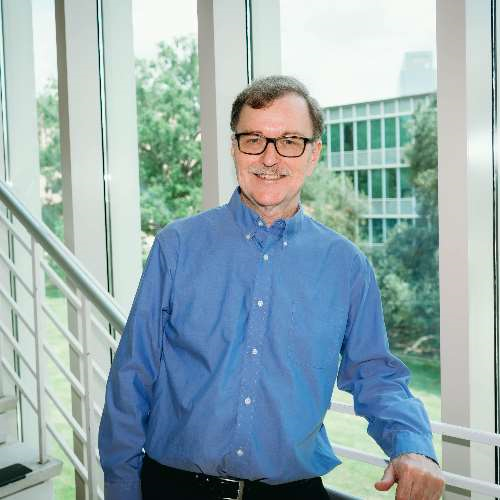
Richard Gordon has made many fundamental contributions to understanding how the crust and lithosphere move and deform in response to plate tectonics. Richard, with S. Stein and students C. DeMets and D. Argus, developed the NUVEL global plate motion model that combined data on spreading rates, transform directions, and earthquake slip vectors to produce rotation poles for the major plates. Later, he and his research groups at Northwestern and Rice made major improvements to NUVEL using new data and insights to create MORVEL. These models are a career-spanning achievement of essential value to researchers everywhere investigating both global and regional geological processes.
Related early work with D. Jurdy developed innovative methodologies to accurately track plate boundaries and motions back to 65 Myr. This single contribution enabled decades of research in the field of modeling mantle dynamics and its relation to global plate motions.
Richard's studies are characterized by rigorous attention to uncertainty and the propagation of errors in the complex process. This was particularly important with respect to inversion of seafloor spreading measurements to derive the relative motion of all the major plates and define and characterize a number of smaller plates. Gordon’s groundbreaking research identified at least three major problems with some assumptions of the original plate tectonics theory. First, global plate interiors are less rigid than originally hypothesized. Second, the earliest models of plate tectonics need the incorporation of diffuse boundaries among oceanic plates; these diffuse zones cover ~15% of the ocean floor. Third, Gordon recognized that global plate reconstructions sometimes need the incorporation of effects of horizontal thermal contractions found in geologically young oceanic lithosphere. He demonstrated that such thermal contractions are also relevant to understanding relative motions among hot spots.
Gordon and D. Argus contributed to western U.S. tectonics by analyzing early space geodetics to document the existence of a Sierra Nevada microplate moving relative to the North American plate. The San Andreas fault was shown to be part of a broad, obliquely convergent plate boundary. He also conceived the concept of paleomagnetic Euler poles to constrain plate motions relative to Earth's spin axis and is a pioneer in estimating the apparent polar wander of the Pacific plate, which demonstrated that the Hawaiian hot spot has shifted south in latitude.
Richard’s research has proven immensely useful to the community, stimulated research in a variety of fields, and led to multiple fundamental new insights about lithospheric dynamics.
—Mary Lou Zoback, U.S. Geological Survey, retired
—Mark D. Zoback, Stanford University, emeritus
See Details
Close Details
Francis Birch Lecture
Received December 1998
Union Fellow
Received January 1989
James B. Macelwane Medal
Received December 1989