

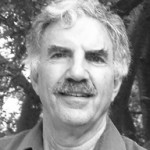

It gives me great pleasure to present the 2008 AGU Roger Revelle medalist, Michael Bender. Michael has tackled an amazingly broad range of problems in ocean geochemistry and biogeochemistry, in all of which he has shown deep scholarship and profound originality. He has a knack for taking on the most intractable of problems and through the development of new measurement techniques and imaginative interpretation of his observations, coming up with truly original contributions that get us all thinking in new directions.
Michael did his Ph.D. with Wally Broecker at Columbia University and was a professor of oceanography at the University of Rhode Island from 1972 to 1997 before joining the Geosciences Department at Princeton University. Most of his early research was on the cycling of metals in the ocean, including valuable insights on the role of hydrothermal circulation and atmospheric deposition. He was also an important contributor to early work on sediment diagenesis, including valuable insights by him and his graduate student Flip Froelich on the zonation of biogeochemical reactions in the sediments and its relationship to thermodynamics.
The primary contributions for which Michael is being recognized today grew out of a visit to the Centre des Faibles Radioactivités, near Paris, in 1983–1984, where he began making measurements of oxygen isotopes in trapped air bubbles in ice cores, building on some ideas he had first begun to explore in 1980 and which he then continued to investigate in his own lab with his graduate student Todd Sowers. His initial paper on this topic was published in 1985, and his contributions since then have included an impressive array of related applications based on measurements of oxygen isotopes and of O2/N2 in firn air, in the atmosphere, and in the ocean. A partial list of his major accomplishments includes the first robust and general methods for temporal correlation among ice cores and between ice cores and sediment records using the 18O/16O ratio and more recently the O2/N2 ratio; dating of ice cores by correlation of these properties with insolation changes; development of the theory of gas isotope fractionation in firn air that was carried out by Jeff Severinghaus working in his lab and that has since had many interesting applications; the use of oxygen isotopes to reconstruct aspects of biospheric productivity over glacial/interglacial cycles; and the use of oxygen isotopes as tools for the study of biological productivity in the ocean.
Michael is the most considerate and thoughtful of colleagues and the most thorough and careful of intellects. He is deeply respected for the strength of his intellect and his unflagging commitment to scientific rigor and personal integrity. I consider myself fortunate to count him and his wife, Yvette Mintzer, as my friends. Michael’s accomplishments have been recognized by his election to fellowship in the Geochemical Society and AGU, his receipt of the Patterson Medal of 1998, and his election to the National Academy of Sciences in 2001. I am happy to see the Roger Revelle Medal added to his well-deserved list of honors.
—JORGE SARMIENTO, Princeton University, Princeton, N. J.