

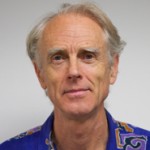

Pieter Tans has dedicated his scientific career to the study of the carbon cycle. He has been the leader in global monitoring of greenhouse gases in the atmosphere since joining the National Oceanic and Atmospheric Administration (NOAA) in the mid-1980s to guide the growth of the NOAA network. Through his leadership, this observation system is now unparalleled in the world, providing near–real time data of the highest quality and making these data freely available to all. These data have formed the heart of numerous publications on atmospheric carbon dioxide and other greenhouse gases and have enabled many additional modeling studies of the carbon cycle by groups from around the world.
Pieter’s accomplishments are many and varied. The following is but a sample:
During his thesis research on historical isotopic ratios of carbon dioxide (CO2) he developed a simple formalism to deal with isotopic exchange that is now universally followed in the field.
His 1990 paper with Inez Fung and Taro Takahashi (Science, 247, 1431–1438) was a landmark work that showed that it was highly likely that the “missing sink” for CO2 lay in the Northern Hemisphere terrestrial biosphere. Later innovative studies by Tans and coworkers used isotopic data to further refine this understanding. Then and now, quantification of this issue is one of the most important for climate change, but Tans and his colleagues’ analysis was the first that correctly showed the direction of the answer.
He led the strategy to deploy denser observations over continents including tall towers and aircraft profiles, which enabled the North American Carbon Program.
His often unheralded but critical support for carbon cycle research in other nations, and his inclusive approach and the transparency of his work as a whole, fostered the growth of greenhouse gas monitoring around the world. The NOAA observations, and NOAA’s development and maintenance of very accurate calibration standards, are the backbone of the Global Atmosphere Watch program of the World Meteorological Organization.
He fostered the development of the CarbonTracker system, now one of the flagships of NOAA research products. This reanalysis and visualization tool has attracted the attention and admiration of policy makers at the highest levels.
He invented one of the simplest scientific instruments ever, the AirCore. It was stimulated by the observation of decades-old air near the bottom of deep firn layers. The AirCore is a very long coil of tubing, lifted by balloon to high altitude, open at one end. During ascent the initial fill air streams out. During descent, atmospheric air streams back in while preserving, like a tape recorder, the trace gas mixing ratios encountered along the way.
Finally, while the global carbon cycle community has benefited most from Pieter’s leadership, scholarship, generosity, and persistence throughout his career, it is clear that society as a whole has benefited as well. Climate and environmental change brought on by the buildup of greenhouse gases in the atmosphere is a global problem that affects us all and will continue to affect generations to come. Pieter Tans was and continues to be the right person at the right time, guiding the world’s premier observing system, devising new ways to use and understand the data, enabling carbon cycle scientists around the world by providing free and timely access to the highest-quality data, and leading the development of carbon cycle science. He is most worthy of the Revelle Medal; it is a privilege to honor his lifetime of selfless commitment to science.
—JAMES W. C. WHITE, Institute of Arctic and Alpine Research, University of Colorado, Boulder