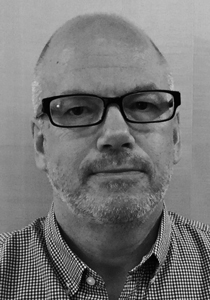
Craig Manning and Bernard Marty will receive the 2017 Norman L. Bowen Award at the 2017 American Geophysical Union Fall Meeting, to be held 11–15 December in New Orleans, La. The award recognizes “outstanding contributions to volcanology, geochemistry, or petrology.”
At a time when many of us focus on models of multidimensional chemical systems, pursue the first measurements of new isotope systems, analyze ever smaller samples, or write short, “silver-bullet” papers, Craig Manning brings exceptional rigor and simplicity to experimental geochemistry. As a result, his experimental results are timeless benchmarks for future work. The same results are timely contributions to understanding complex topics such as the evolution of aqueous fluids in subduction zones, and speciation in fluids at high pressure. This is a unique combination. In his dedication to a simple, physical chemistry approach, Craig stands alone among his generation of experimental petrologists. His insight into design of single-phase solubility experiments, and their application to multiphase, multicomponent systems, is unmatched. Craig’s work calls to mind the giants of experimental geochemistry: Norman Bowen, who merged observational geology with the rigor of chemical thermodynamics; George Kennedy, whose experiments brought similar discipline to hydrothermal systems; Hal Helgeson, who, like Bowen, brought physical chemistry to bear on the study of water–rock reaction; and Bruce Watson, whose innovative experiments showed a generation how mineral solubility data could be applied to real geologic problems. Craig is a sought-after and conscientious advisor, with many first-author papers by his students. He is an experienced field geologist who spent many seasons in Greenland and the Himalaya. He has published more than 95 papers during this century, so one might expect him to be something of a nerd. Yet this is far from the truth. Craig’s wife, Becky, is an accomplished filmmaker, producer, and professor at UCLA, and he spends much more time socializing with Becky’s interesting colleagues than with boring geoscientists. He’s a great reader, a generous friend, and a sophisticated traveler. Craig brings honor, credibility, and style to the Bowen award, AGU, and geoscience in general.
—Peter Kelemen, Columbia University of New York
Thank you, Peter. Your eclectic list of geochemical greatness emphasizes my convoluted path, starting with Bowen’s The Evolution of the Igneous Rocks, assigned by Barry Doolan for my undergrad petrology class at the University of Vermont. I was hooked from the first phase diagram and probably should have foreseen my future as an experimentalist. Instead, I went to Stanford to work on ophiolites with Bob Coleman, then with Dennis Bird, who was rigorously applying thermodynamics to the fossil hydrothermal systems of East Greenland. I got hooked on that too, and we had so much fun discovering how they worked while defending ourselves in the Arctic. A newly minted aqueous geochemist cannot fail to notice the complex high-pressure veining of the Franciscan Formation, but it was frustrating to discover that the beautiful Helgesonian framework for solutes only worked to 5 kilobars. I persuaded Steve Bohlen to take me on for a postdoc at the U.S. Geological Survey. His enthusiasm and willingness to try anything spurred my initial attempts to measure high-pressure quartz solubility in water while I was not working on other things. I was too dumb or obstinate to accept the many failures. Finally, enough capsules held that upon arriving at UCLA I repurposed Art Montana’s piston cylinders for their true calling: determining high-pressure mineral solubility in fluids. Bob Newton eventually joined the fray; he has provided constant inspiration and lasting friendship. Meanwhile, An Yin and Mark Harrison indulged returns to my field roots in the deserts of central Asia. Like so many past recipients of this honor, I can testify that traveling the anastomosing paths of field and experimental study will always reward. Thanks to all of you, to my parents for creating a family of Earth and environmental scientists, and to Becky for companionship, insight, wit—and friends.
—Craig Manning, University of California, Los Angeles