

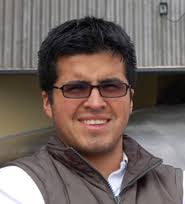

Germán Prieto is an outstanding young seismologist of exceptional ability. Germán went to graduate school at the Scripps Institution of Oceanography, San Diego, Calif., and earned his Ph.D. in 2007. He was at Stanford University, Stanford, Calif., through 2008 as the Thompson Postdoctoral Fellow and is now on the faculty at the Universidad de los Andes, in Bogotá, Colombia. Germán’s work is consistently innovative and is characterized by a powerful combination of theoretical and practical insight.
Germán’s thesis research work with Peter Shearer and Frank Vernon focused on the earthquake source, and he developed a new approach for analyzing large waveform data sets that led to source parameter estimates for an order of magnitude more earthquakes than any previous study. This work provides some of the strongest evidence extant for self-similarity in the earthquake source.
During his postdoc, Germán’s research took a different direction. He used deconvolution to recover Green’s functions from the ambient field in a way that preserves amplitude, and he predicted basin response for a moderate earthquake in Southern California based on these Green’s functions. This opens a new approach to seismic hazard analysis at long periods that will see widespread application in the future.
In 2009, Germán developed the first technique to recover anelastic structure from the ambient field, which creates new opportunities in structural seismology. It is particularly fitting that he receive this award, because in developing this method he went back to the original spatial autocorrelation formulation developed by Kei Aki himself in 1957. Most recently, Germán and Jesse Lawrence have used attenuation measurements from the ambient field as the foundation for attenuation tomography of the western United States with spectacular results.
In his short career, Germán has pioneered new techniques to address important research problems spanning an increasingly broad range of topics. We can expect great things from him in the future.
—Gregory C. Beroza, Geophysics Department, Stanford University, Stanford, Calif.