

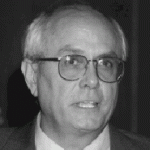
Mike Hall has been the preeminent civil servant involved in the creation of modern Earth systems science. Through more than 30 years of public service, he has built an unparalleled record of innovation and leadership in mobilizing scientific talent and government resources for global scale, internationally organized research programs in weather, climate, oceanography, and the environment.
Dr. Hall’s record of accomplishments reflects a continually expanding vision of how the very best science can be mobilized in the service of society. Early in his career, he played a central role in conceptualizing the notion that the ocean should be systematically “observed” through a network of buoys. This was merely the first of his many contributions to the emergence of today’s global Earth observing system. His stewardship of the Tropical Ocean Global Atmosphere (TOGA) program was instrumental in facilitating the effective collaboration between atmospheric and oceanographic sciences that ultimately demonstrated the predictability of El Niño and the Southern Oscillation (ENSO). TOGA stands today as the gold standard for effective international programs in the geosciences.
Building on his TOGA experience, Dr. Hall became the principal advocate of a truly interdisciplinary approach to the U.S. Global Change Research Program. When almost no one else was doing so, he took the lead in reaching out to bring biological and, especially, social scientists into the effort as the fully integrated partners they have become today.
Recognizing more than a decade ago that excellent Earth systems science was necessary but not sufficient for managing the challenges of global change, Dr. Hall began encouraging a series of experiments in how to bring the users and producers of such science closer together in partnerships. His development of a Climate and Social Interactions group within NOAA, his advocacy for a use-driven International Research Institute for Climate Prediction, and his support for research on the efficacy of different ways to integrate research, observation, assessment, and decision support have paved a way that others are only now beginning to follow.
In building his unparalleled record of programmatic accomplishments, Mike Hall has defined the model of a scientific program manager. He has shaped exciting research programs by listening carefully to the views, opinions, and concerns of a broad range of scientists and users, creatively synthesizing the best of what he hears, and then pushing us just a little beyond what we thought we could do.
He has demonstrated that personal integrity and a commitment to putting programmatic goals ahead of bureaucratic self-interest can build powerful interagency coalitions to support such programs. He has cultivated scientific excellence by seeking out the best researchers no matter where they are in the world, running fiercely competitive grants programs, but still betting occasionally on the unconventional and untried. He has had the courage to fail, launching risky experiments, but insisting on learning from them through the use of independent and transparent program evaluations from his toughest critics. Perhaps most important, he has fostered young talent, training and supporting the professional development of a generation of the best science program managers in today’s civil service.
For his vision, his innovations in program management, his nurturing of young talent, and his deeply held values that have so advanced science in the service of humanity, I join with my assembled colleagues in proudly presenting to J. Michael Hall the AGU Waldo E. Smith Medal
—WILLIAM C. CLARK, Harvard University, Cambridge, Mass.