

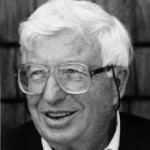
John Knauss has served as a leader and key decision-maker in the scientific community and the public sector for nearly six decades. From the start of his career he focused on the most fundamental elements of the physical dynamics of the ocean, developing the seminal thinking in topics as diverse as turbulence effects on acoustics and deep ocean current observations. His early work on the Cromwell current established John as a leading researcher in the geophysics community. He quickly established a global reputation for his seminal work on the current structure of many major ocean circulation features. By the mid 1960s, Knauss had already established his scientific credentials and leadership role, with a robust bibliography of technical papers in the most prestigious scientific journals. Notably, in the years leading to this position, John also worked as a naval officer at the newly formed U.S. Office of Naval Research and as a staff member of the Scripps Institution of Oceanography (La Jolla, Calif.).
In the late 1960s, John’s career took on a new component: public policy. John was appointed by U.S. President Lyndon Johnson to serve on the Stratton Commission. This commission provided our nation’s most comprehensive set of recommendations regarding marine policy to that time. One outcome of the Stratton Commission recommendations was the establishment of the National Oceanic and Atmospheric Administration (NOAA), for which President George H.W. Bush appointed Knauss as administrator in 1989. Two other American presidents appointed Knauss to serve on the National Advisory Committee on Oceans and Atmospheres. It is most noteworthy that John served in these leadership capacities at a time when American ocean policy development included passage of essential legislation dealing with coastal zone management, marine protected areas, marine mammal protection, and clean water preservation. Not surprisingly, in 1988 the U.S. Congress passed legislation changing the name of the Sea Grant Fellowship Program to the Dean John A. Knauss Fellowship Program. John also served as President of the American Geophysical Union from 1998 to 2000. But John’s service in public policy was not limited to U.S. activities. He also advised the State Department and the United Nations Convention on Law of the Sea, was an officer of the Intergovernmental Oceanographic Commission, and served as the U.S. Commissioner to the International Whaling Commission during critical periods for all of these bodies.
John Knauss’s breadth of technical expertise, management experience, and leadership in public policy are reflected in his extraordinary portfolio of recognition. He has received numerous awards from universities, governments, and professional societies. He is a Fellow of three societies, has been inducted into the Rhode Island Heritage Hall of Fame, and received an Honorary Doctor of Science from the University of Rhode Island. The casual reader of John’s curriculum vitae cannot but be overwhelmed with the breadth and depth of his accomplishments. By any metric—publications, awards, positions of public service, or advisory roles—John Knauss has exemplified the elements of ‘unique leadership’ and ‘extraordinary service.’ It is for this reason, above all, that John Knauss is a most worthy recipient of the Waldo E. Smith Medal of the American Geophysical Union.
—RICHARD W. SPINRAD, NOAA, Washington, D.C.