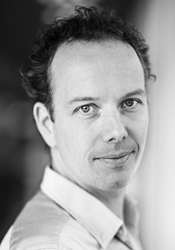
Amir AghaKouchak, Anton Artemyev, Emily V. Fischer, Francis A. Macdonald, and Erik van Sebille were awarded the 2019 James B. Macelwane Medal at AGU’s Fall Meeting 2019 Honors Ceremony, held on on 11 December 2019 in San Francisco, Calif. The medal is for “significant contributions to the geophysical sciences by an outstanding early career scientist.”
Erik van Sebille has quickly established himself as a world-leading scientist in applying Lagrangian techniques to study a range of oceanographic problems. His work has fundamentally advanced our understanding of ocean dynamics and the global transport of plankton and plastics. Erik is a highly creative and skilled scientist, with a knack for seeing opportunities to produce new scientific analyses to address tough problems in areas that have a direct societal impact. Erik works in a highly collaborative way, engaging with many groups and communities, applying his wares to fields ranging from oceanography through to mathematics, paleoclimate, and marine ecology.
In his research, Erik combines models and data to study how currents move tracers and particulates around the global ocean. This has resulted in high-impact papers in Lagrangian oceanography and in the ocean transport of water, heat, nutrients, microbes, plankton, and plastic around the world. With a keen eye to being an enabler of research for others, Erik has led the development of a new, cutting-edge open source software framework for Lagrangian ocean analysis, known as OceanParcels (oceanparcels.org), which is now widely used by the community. Over the past decade Erik has rapidly broadened his work using Lagrangian techniques to track more than just water masses: exploring how ocean currents determine the fate of plastic, plankton, and other floating matter. Erik’s work on plastics in the ocean has had a remarkable impact on our understanding of this global environmental problem.
Apart from being an exceptional scientist, Erik is known for his strong commitment to public outreach and community engagement. He is a regular commentator in the media, a superb teacher and communicator, and a willing mentor to research students and early-career scientists. Erik has taken on leadership roles in both national and international science programs. Erik’s insights are deep, and the problems he works on are vital for protecting the world’s ocean environment.
On a personal note, I have to say that it has always been a great pleasure to work with Erik. I have marveled at his energy and passion for ocean science, his flair for coming up with exciting new problems to tackle, and his ability to devise novel applications of Lagrangian methods. I am certain that we will be hearing much more about Erik’s discoveries for many years to come. Please join me in congratulating Erik for this well-deserved honor of the James B. Macelwane Medal.
—Matthew H. England, University of New South Wales, Sydney, Australia
Thank you, Matt, for these very kind words. And thanks to you and my other supporters and nominators for their time and efforts. I truly am very excited and humbled to receive this James B. Macelwane Medal.
I’ve been lucky in my career to have been surrounded by inspiring, good-natured supervisors, colleagues, and collaborators, who’ve shown me how much fun it can be to be an academic: Will de Ruijter, Peter Jan van Leeuwen, and Femke Vossepoel at Utrecht University encouraged and inspired me to find my own edge in research; Lisa Beal and Bill Johns at the University of Miami’s Rosenstiel School of Marine and Atmospheric Science instilled a huge appreciation for oceangoing research and the hardship and effort that collecting data in the field requires; Matt England at the University of New South Wales Climate Change Research Centre has encouraged me to look beyond physical oceanography and to collaborate with biologists, geneticists, mathematicians, archaeologists, ornithologists, fisheries economists, and many other fields I’ve since published with; Joanna Haigh and Martin Siegler at Imperial College London’s Grantham Institute have introduced me to policy and advocacy and shown me how to make a real impact; and Henk Dijkstra at Utrecht University gives me full freedom to explore and chase my own interests. Add to that all the fantastic and inspiring collaborators and coauthors (over 480 of them!), and I can really say I’m standing on the shoulders of giants. Looking back, it may seem like my career path was all nicely planned, but of course, much of this was serendipity and being in the right place at the right time. I am fully aware and appreciate that I’m privileged and realize that not everyone has access to these chances and opportunities.
Our global society is changing so fast right now that we scientists cannot simply keep doing our work like we’ve always done. To stay relevant, we need to change every aspect of our research: planning our research through cocreation with the broader society; conducting our research in a fully transparent, inclusive, and collaborative way; communicating our research to peers and the broader public; and getting recognized and rewarded in an unbiased way; society rightly demands radically open science. The tools and ideas for this radically open science are in place; now it’s up to us as a scientific community to embrace them. These are exciting times!
—Erik van Sebille, Utrecht University, Netherlands