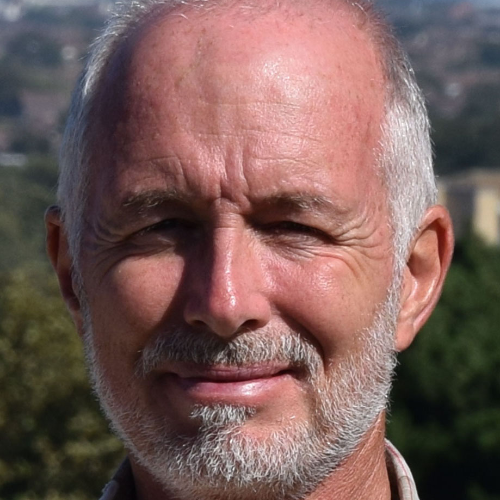
Norman L. Bowen Award and Lecture
Tim Druitt and Steven Goldstein will receive the 2018 Norman L. Bowen Award at AGU’s Fall Meeting 2018, to be held 10–14 December in Washington, D. C. The award recognizes “outstanding contributions to volcanology, geochemistry, or petrology.”
Tim Druitt and Steven Goldstein will receive the 2018 Norman L. Bowen Award at AGU’s Fall Meeting 2018, to be held 10–14 December in Washington, D. C. The award recognizes “outstanding contributions to volcanology, geochemistry, or petrology.”
Citation
Tim Druitt has made many fundamental contributions to petrology and volcanology. Tim displays breadth and originality and in the past several years has been a key figure in the revolution in understanding how rapidly large silicic magma chambers are assembled before eruption. His research is characterized by meticulous petrological observations, astute analysis, and interpretative originality. His contributions include masterly elucidation of the geological history of Santorini volcano; pioneering work on the geology of ignimbrites; novel laboratory and modeling studies of pyroclastic flow and debris avalanche dynamics; contributions to understanding caldera formation; insightful studies of Vulcanian explosion dynamics at Soufrière Hills volcano in Montserrat; and exceptionally high quality volcanological, petrological, and geochemical studies of the products of explosive caldera-forming eruptions, notably at Mount Mazama and Santorini.
Tim has had a recent burst of originality through his exhaustive petrological studies of Santorini rocks, focusing on the Minoan eruption. He has used diverse modern petrological methods to extract a compelling explanation of how large silicic magma bodies are assembled before major explosive eruptions. This work is a game changer showing that very large volumes (many cubic kilometers) of silicic magma are transferred into the upper crust in a remarkably short time (less than a few centuries). A series of recent papers with students and collaborators, starting with the already seminal 2012 Nature paper, have developed a new paradigm based on detailed geological characterization of the Minoan deposits, melt inclusion studies, use of major and trace element zoning patterns as a geochronometer to constrain crystal residence times, and experimental studies. This work demonstrates the rapid assembly of the Minoan chamber within a few centuries with the silicic melts originated from deeper sources in the middle crust. Last but not least, Tim is well known for his calm, collaborative, and collegial approach to science and to mentoring students.
—Steve Sparks, University of Bristol, Bristol, U.K.
Response
I am truly honored to receive the Bowen Award. Thank you, members of AGU, and thank you, Steve, for your kind nomination. Several people had a big impact on me during my early career. As an undergraduate I was particularly influenced by the late Stuart Agrell, and then as a master’s student by Roger Powell. Steve Sparks took me on as a research student and taught me to view volcanic systems holistically, to try and always quantify, and to make research fun. Working with Fred Anderson in Chicago exposed me to melt inclusions and to Fred’s profound insight into magmatic processes. During my postdoctoral fellowship at Menlo Park, Charlie Bacon convinced me of the benefits of persistent, focused studies of single volcanic systems. Doing research first in the United Kingdom, then at the U.S. Geological Survey, immersed me in the two great schools of explosive volcanism. My own approach has been to try and address fundamental questions on magmatic systems while having a long-term laboratory volcano, Santorini, to guide me in those questions and to test hypotheses. I have found this dual approach to be both productive and intellectually satisfying. It has allowed me to constantly learn new techniques, to collaborate with great people with skills different from my own, and to advance incrementally in the understanding of my chosen volcanic system. Throughout, my wife, Mary, and daughter, Fabienne, have kept me sane in a wonderful family life and put up with my many absences. I have enjoyed working with a team of fantastic Ph.D. students, postdocs, and colleagues who have taught me a great deal. Being paid to do research with bright and motivated people who share my curiosity for the natural world is a remarkable thing. I gratefully accept this award on their behalf, as well as on my own.
—Tim Druitt, University of Clermont Auvergne, Clermont-Ferrand, France