

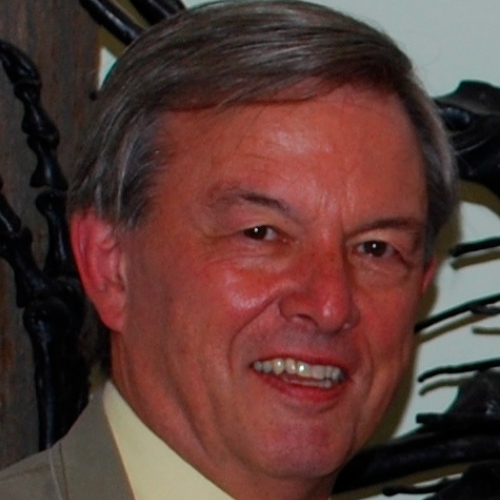
Modern global earthquake monitoring, enabled by developments in seismometry and partnerships among academic and government institutions, is a fundamental component of international geoscience infrastructure. In addition to supporting fundamental research, monitoring provides the essential information needed to improve our preparation for and response to earthquake disasters. For U.S. seismologists and their collaborators, the Incorporated Research Institutions for Seismology (IRIS) has been the backbone organization supporting the acquisition and management of data underpinning seismological research, education, and applications. The individual most responsible for IRIS’s record of success is David Simpson, who has served as its President since 1991.
After receiving his advanced degrees from Dalhousie and the Australian National University, David began his academic career at the Lamont-Doherty Geological Observatory. At Lamont, he conducted research on induced seismicity and satellite remote sensing. His move to the presidency of IRIS was meant to be temporary, but he was prevailed upon to stay.
David personifies the qualities celebrated by the Smith Medal. His imprint on geophysics is evident in the keen dependence of Earth scientists on IRIS facilities, and the precision with which those facilities are managed. The IRIS model of open governance, agency and international partnerships, technical development, and efficient management and operations is held by many to be the ideal blueprint for shared scientific facilities. The IRIS consortium, comprising virtually all of the U.S. academic institutions engaged in seismological research as well as a multitude of government and international partners, is itself the archetype for scientific community building and engagement. But the success of all of this is built on the confidence that there is a good captain at the helm, that there is aggressive stewardship of the principles of operational excellence and free exchange of data, and that there is a leader that can represent the broadest interests of the community. David embodies all of this, and more.
Perhaps nowhere is this more evident than in the rapid growth in the number of institutions with leading programs in seismology, and the impact IRIS facilities have had on early-career seismologists. It is now possible to be at any institution and have access to earthquake data in near real time, as well as to the most sophisticated instrumentation for targeted field experiments. Additionally, young scientists find that the technical barriers to data acquisition have been so lowered as to be essentially irrelevant to their productivity. Now, a lifetime of data is available for analysis.
Given the expansion and vitality of observational seismology enabled by IRIS, one might expect a certain satisfaction about the state of seismological data acquisition. Seismologists certainly are a happy bunch. But it is clear that the coherence of the IRIS consortium empowers young and old with the tools to think big. EarthScope is but one example. The recent Cascadia Initiative is another. These are the results of responsive leadership and discriminating judgment. David Simpson is a fitting reminder of why the AGU celebrates “extraordinary service to geophysics” with the Smith Medal.
–Arthur Lerner-Lam, Lamont-Doherty Earth Observatory, Palisades, N.Y.