

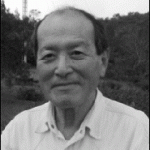
Kei Aki’s scientific research has expanded the frontiers of seismology for 50 years. He pioneered the electronic processing of seismic data to infer Earth structure and properties of the earthquake source. Much of what we know about large earthquakes follows from his work.
He was the first to measure seismic moment (for the 1964 Niigata earthquake); Aki moment has since replaced Richter magnitude as the fundamental measure of earthquake size. He discovered the fundamental scaling laws for seismic spectra that resolved inconsistencies among different magnitude scales, and he proposed physical models of earthquakes for heterogeneous fault rupture. This work contributed significantly to both the basic understanding of the rupture process and the practical understanding of strong ground motions.
He elucidated the scattering and attenuation processes that govern the propagation of high-frequency seismic waves, from which he derived new methods for measuring earthquake size, scattering distributions, and intrinsic attenuation parameters. He demonstrated, for instance, that the intrinsic attenuation must decrease at high frequencies.
He developed many novel approaches for describing aspects of seismic waves, including free-oscillation splitting, Gaussian beams, and boundary integral methods. In each case, he and his students successfully used these techniques to extract new types of information from seismograms.
He pioneered travel-time tomography as a means to study lithospheric structure beneath dense seismic arrays, publishing seminal papers almost a decade ahead of its widespread application to global seismology. He established new seismological perspectives on volcanic processes, including the relationship of seismicity and harmonic tremor to magma injection and eruption. He detected fault-zone guided waves and used their propagation characteristics to constrain the width and elasticity of the damage zones around faults.
As impressive as this abbreviated list might sound (more topics could easily be added), it fails to communicate Kei’s true impact within the geoscience community. He literally wrote the book Quantitative Seismology, the most influential textbook and reference manual in the history of the field, which he coauthored with Paul Richards in 1980.
As a teacher and mentor, he entrained many bright students in his quest to understand the active Earth, producing over 50 Ph.D.s who now occupy key positions in seismology worldwide. His success in guiding young scientists stems in part from the depth of his understanding, but also from his remarkable personal qualities-charm, wit, and a deep respect for the harmony and poetry of the natural world.
Kei’s quiet leadership in seismology has demonstrated the subtlety and power of unselfish cooperation in research. He has held many positions: president of the Seismology Section of AGU, president of the Seismological Society of America, chair of the NAS Committee on Seismology.
But his greatest leadership achievement was the creation of the Southern California Earthquake Center in 1991. As its founding director, Kei articulated a vision for SCEC in which the investigations by disciplinary working groups would be woven together into a system-level ‘master model’ for earthquake hazard and risk in Southern California. The master-model concept led to many advances in seismic hazard analysis, such as the incorporation of GPS data into long-term earthquake forecasting, and it continues to guide the growing SCEC collaboration.
Some scientists loom so large in their fields that we must mark their impact with special honors. Kei Aki, the 2004 recipient of the William Bowie Medal, is one of our giants.
—THOMAS H. JORDON, University of Southern California, Los Angeles