

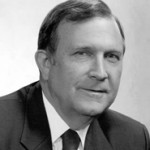
For most of the past 40 years, Fred Spilhaus led AGU with dedication, creativity, and leadership, making AGU a model union and a strong integrating force and professional home for Earth and space scientists across the globe. That AGU is held in such high regard stems mainly from Fred’s insistence that the Union be inclusive of all Earth and space scientists and that scientific quality and integrity hold the highest priority. Fred also bequeathed to AGU long-term financial stability.
Fred obtained a Ph.D. in physical oceanography in 1965 from the Massachusetts Institute of Technology and after 2 years of government experience joined AGU in 1967 as assistant executive director under Waldo Smith. That same year, the Solar Terrestrial Relations (now Space Physics and Aeronomy) section was formed, an action important for AGU, as space physics was a rapidly growing field without its own society. Fred became AGU executive director in 1970, a time when AGU was on the move. Radio Science had just become an AGU publication (1969), the Union was incorporated as an independent scientific society with members gaining the right to vote and hold office (1972), Geophysical Research Letters began publication (1974), and Chapman Conferences started (1975).
Fred ensured that AGU was popular by keeping fees low and by providing Eos (of which he was editor in chief) to all members. Fred’s efforts to bring meetings to underserved geographical areas (the Western Pacific Geophysics Meeting and the Meeting of the Americas) had a similar purpose. He recognized that younger scientists often could not afford to travel to the United States, so he brought the meetings to them.
Fred often said that strong national societies are critical to the strength of geophysics. His spirit of inclusiveness extended throughout the Union; its robust committee structure gave members an opportunity to take an active role in directing AGU. Fred also generously supported and accommodated fledgling scientific societies (The Mineralogical Society in its early years) and other groups such as the Global Change System for Analysis, Research, and Training and the Consortium of Universities for the Advancement of Hydrologic Science, Inc.
Fred was elected an AGU Honorary Fellow in 1996. To this day, only three people have been given this prestigious award. It was given in recognition of a lifetime of achievement on behalf of AGU, but many years of service and accomplishments lay ahead. Milestones since then included establishment of Earth Interactions, the first electronic—only journal in Earth and space science; election of the first European member of the Council; creation of the Biogeosciences section; establishment of a complete electronic publication system; and the first Union-wide meeting in Latin America. Over 55,000 AGU members now benefit from Fred’s vision and hard work.
Fred is widely known as the dean of scientific society executives and has been highly commended for sharing his experience with the Council of Engineering and Scientific Society Executives (CESSE). In 2009, CESSE renamed its highest honor the A. Fred Spilhaus Leadership Award. It has been awarded only eight times, including to Fred in 1995. In announcing the name change, CESSE noted that the board wanted “Fred’s name to be tied to this honor forever.”
Both of us have known Fred for many years. We have seen his personal involvement in the Council, in all meetings of the Union, and in other international organizations. Whatever the issue, Fred seemed more knowledgeable than most and had a keen sense of the best course of action. His engaging personality and strong leadership characteristics make him easy to know and fun to be around. It is indeed an honor for us to present the Waldo E. Smith Medal to Fred Spilhaus.
—CHRISTOPHER HARRISON, University of Miami, Miami, Fla.; and JAMES BURCH, Southwest Research Institute, San Antonio, Texas