

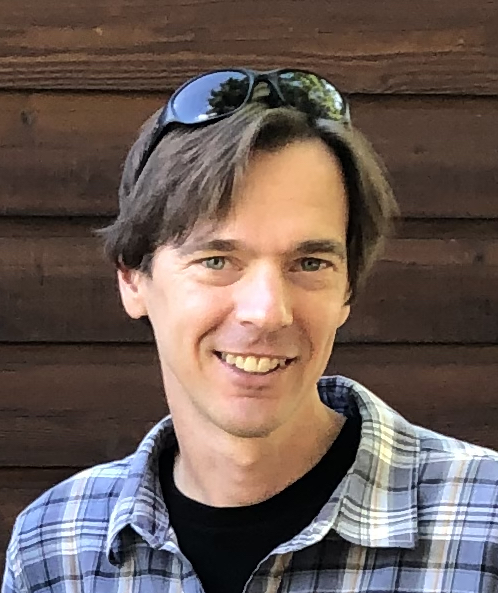

David R. Shelly is awarded the 2012 Macelwane Medal for his revolutionary advances in understanding the nature of tectonic tremor and its role in the earthquake preparation process. His innovations in the study of this subtle “noise” from deep within the Earth has opened a new window into the processes governing the earthquake cycle on major plate boundary faults and the magmatic systems beneath active volcanoes.
Tectonic (aka “non-volcanic”) tremor was initially recognized as an enigmatic seismic signal associated with subduction beneath Japan. David’s innovative use of cross-correlation techniques on continuous waveform data enabled him to discover that tremor consists of many, overlapping low-frequency earthquakes (LFEs) on the subduction interface, rather than being generated by fluid dynamic processes as many had speculated. David discovered migration patterns within the tremor associated with geodetically detected slow-slip events (together known as episodic tremor and slip or ETS), providing a means of tracking the spatial progress of individual slow-slip patches comprising an ETS event.
Turning his attention to the San Andreas Fault in central California, David showed that the tremor is confined to a long, ribbon-like band in the lower crust directly beneath the seismogenic fault and that, as in subduction zones, the tremor consists of many superimposed shear-slip events. This provided the first clear evidence that the central section of the San Andreas Fault extends entirely through the crust as a vertical, strike-slip fault rather than terminating in a lateral decollement at midcrustal depths as many had proposed. David identified a wide range of tremor migration patterns, including asystematic migration away from the eventual epicenter of the 2004 magnitude 6 Parkfield earthquake, which, analogous to subduction zones, may indicate a precursory slow-slip event at depth. David discovered patches of repeating LFEs that display an intriguing array of temporal patterns ranging from periodic to period-doubling to chaotic suggesting that small changes in conditions can produce dramatic changes in behavior as is characteristic of complex systems. He has recently expanded his research to include volcanic seismicity and tremor in major volcanic systems.
Awards recognizing David’s contributions include the AGU Keiiti Aki Young Seismologist Award, the Presidential Early Career Award for Scientists and Engineers, and the Seismological Society of America’s Charles H. Richter Early Career medal. These many accomplishments and accolades have not altered David’s modest, unassuming demeanor. He is a delightful colleague and valued collaborator with a balanced approach to science and life.
–Jeanne Hardbeck, U.S. Geological Survey, Menlo Park, California; and David Hill, U.S. Geological Survey, Menlo Park, California
David R. Shelly has emerged as one of seismology’s young stars. He has had an impact on the field of seismology that is all out of proportion to his age due to his work on deep, nonvolcanic tremor. It is no exaggeration to state that David’s work revolutionized our understanding of this newly discovered seismic source—a remarkable accomplishment for a Ph.D. student.
During a summer spent at the University of Tokyo, David studied low-frequency earthquakes (LFEs), which were discovered by scientists in Japan. LFEs are small and occur almost exclusively during periods of tremor. He discovered that LFEs occur on the plate interface, and concluded that they represent plate-boundary slip. David subsequently demonstrated that tremor under the island of Shikoku consists of a swarm of LFEs. His work made sense out of signals that had defied interpretation. Before David’s work, tremor mechanisms focused on a coupling of fluid movement to the solid Earth, but he demonstrated that tremor in Japan, and presumably elsewhere, is generated by shear slip. His result stands as a true research breakthrough that may have more generally important implications for the earthquake process because tremor has now been discovered in diverse tectonic environments. In subsequent work, David documented rapid migration and strong tidal triggering of tremor. These, too, are important results. Most recently, he reported the discovery of a horizontal streak of tremor on the deep extension of the San Andreas Fault.
David has a knack for identifying important problems, is creative in solving them, and has a talent for extracting subtle information from immense volumes of data. He has the potential to become one of the world’s leaders in observational seismology. For all of these reasons he is a worthy recipient of the inaugural Keiiti Aki Young Scientist Award from the Seismology section of AGU.
—Gregory C. Beroza, Stanford University, Stanford, Calif.