

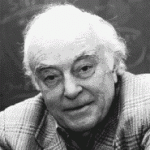
“John Simpson is, quite simply, one of the great men of space science. His accomplishments, spanning a half century, both in scientific research and in the realm of science and policy, are unusually significant and important. Some of his contributions have become, over time, so much a part of our world that they may be taken for granted and are, perhaps, unfamiliar to many. Because of space limitations, only a subset of his many accomplishments can be mentioned here.
“Simpson is the father of the neutron monitor, one of the fundamental tools for studying the intensity variations of cosmic rays. Cosmic rays respond to variations in the solar wind and thus probe the heliosphere in remote regions. Today, a worldwide network of neutron monitors continues to be a uniquely valuable system for the study of solar-terrestrial phenomena. Indeed, for nearly 50 years, much of what we know of the heliosphere and solar-terrestrial relations has come from neutron monitors.
“He led in the development of space-borne detector systems and has been responsible for a number of important discoveries regarding cosmic rays and the heliosphere. His early work established the heliospheric nature of cosmic-ray variations. He and collaborators uncovered unusually large fluxes of energetic helium in the heliosphere, a component that we now know as anomalous cosmic rays, which are interstellar pickup ions accelerated at the heliospheric termination shock to energies of hundreds of MeV. His recent discovery of a significant north-south asymmetry of cosmic rays in the heliosphere may prove to be very important. In parallel with his work on the heliosphere, his work on the abundances of galactic cosmic rays has illuminated the nature and origin of galactic cosmic rays.
“An inventor of a number of particle detection techniques, John Simpson led the development and the first use of silicon detector technology for charged particle composition measurements. Among his latest inventions is a fast response mass spectrum detector for cosmic dust. Flying his dust instrument on the USSR’s Vega 1 and 2 spacecraft, he investigated the masses and spatial distribution of dust near Comet Halley.
“With such an impressive and wide-ranging list of scientific contributions, it is almost incredible that the same person was responsible for a number of extremely far-sighted and important contributions to science policy issues over the years. While still quite young, in 1945, he was the first Chairman of both the Atomic Scientists of Chicago and the Bulletin of the Atomic Scientists. Simpson was among the early leaders who educated the public and political leaders on the dangers and benefits of the nuclear age. In particular, he was active in supporting what became known as the Atomic Energy Act of 1946, placing the administration of atomic energy in civilian hands. During the 1956-1957 International Geophysical Year, he was responsible for resolving issues of atmospheric testing of nuclear weapons.
“In 1958, Simpson was a founding member of the Space Science Board (SSB) of the National Academy of Sciences. He chaired the SSB committees to develop experimental and theoretical programs investigating energetic particles, plasmas, and magnetic fields in space and to encourage U.S. investigators to propose to the then new NASA.
“In 1970-1971, Simpson was the first Chairman of the new Division of Cosmic Physics (now Division of Astrophysics) of the American Physical Society, and in 1982 he founded the Space Science Working group to defend space sciences and encourage support in Congress for the U.S. space science programs.
“In spite of all these accomplishments, Simpson remains a very stimulating and easy person to interact with. He shares his knowledge, skills, and dedication with the younger generation. His students have gone on to successful careers as excellent scientists and as directors of major laboratories and members of the National Academy of Sciences. He has been a leader in promoting international collaborations in science.
“In summary, John Simpson is a towering figure in science. In a long and scientifically productive career, he has exhibited unparalleled performance, dedication, generosity, and influence and thus exemplifies those qualities that the Bowie Medal was intended to honor.”
—JACK R. JOKIPII, University of Arizona, Tucson, USA